
Before you start
- Define the vegetation and trees in scope.
- Ask what stump height and debris size to expect.
- Choose the next step for the cleared area before work begins.
What the machine does
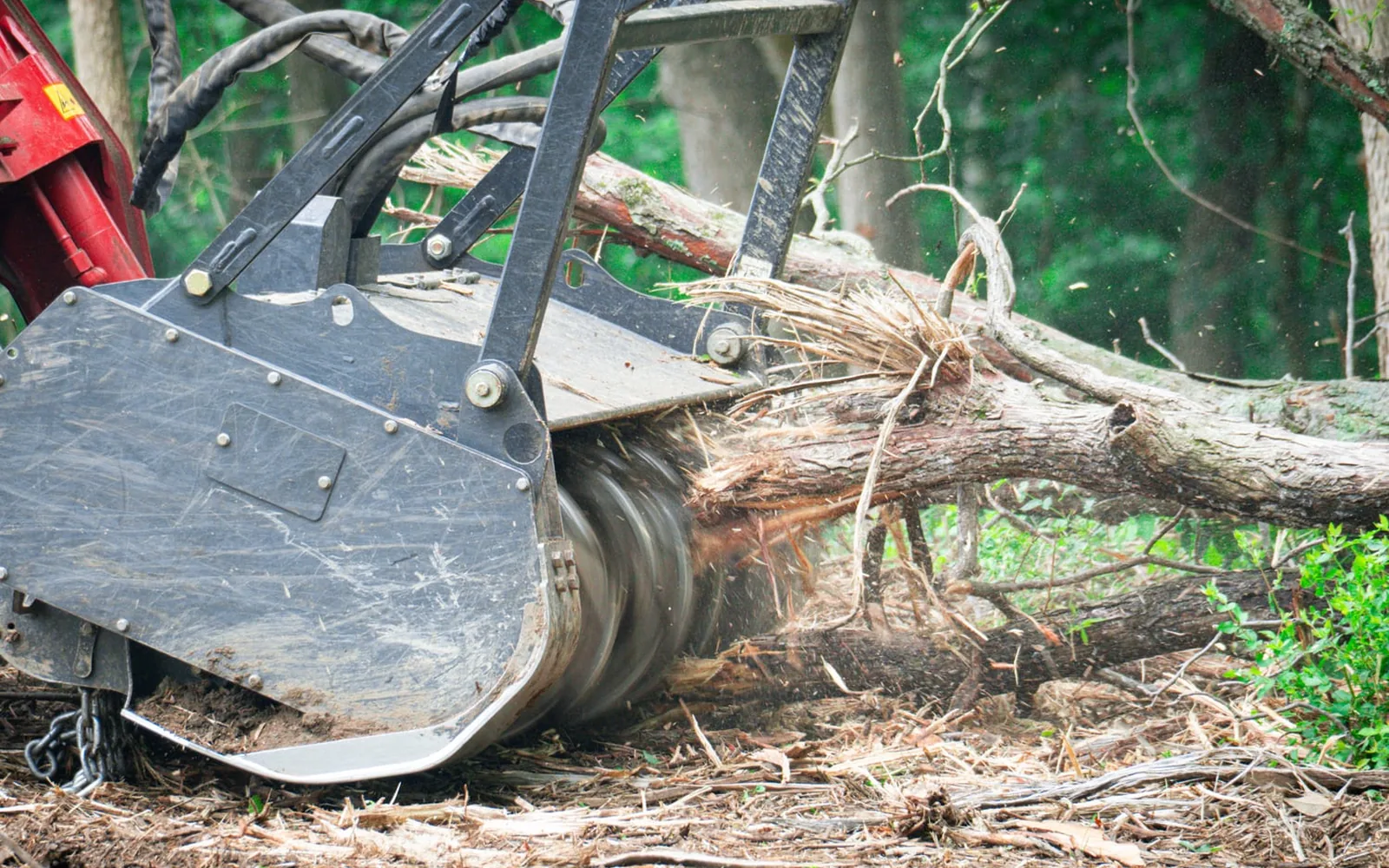
A forestry mulching attachment cuts and processes suitable vegetation where it stands. The processed material usually remains on the ground instead of being collected in a brush pile. Suitable vegetation depends on the machine, attachment, site, and operator assessment.
This can be useful for opening brushy ground while retaining selected trees. It is not the same as excavating roots, reshaping the land, or removing every piece of organic material.
Choose a realistic ground finish
Expect a rough surface unless another finish is specified. Chips, woody pieces, stump remnants, roots, and uneven ground may remain. Ask the contractor to show a relevant finished example and explain how your site could differ.
A walking opening, mowable area, lawn, driveway, and building pad are different outcomes. The last three generally involve preparation beyond processing vegetation. Agree on that sequence before the estimate becomes a work order.
Where a different method may fit
Large or hazardous trees, tight spaces beside structures, buried wire, rubbish, wet ground, and unstable slopes may need other equipment or a specialist. A mixed approach can be more appropriate than trying to force one machine through the entire parcel.
If the next contractor must excavate roots and remove organic material, ask whether mulching the same footprint first is useful. Selective access clearing may help the evaluation while direct removal suits the structural area.
Plan for what returns
Clearing opens the ground; it does not permanently eliminate all plants. Surviving roots and new seedlings can produce growth after the first pass. Choose a maintenance approach that suits the intended use and the plants present.
Keep access for inspections and later work. A cleared pocket that cannot be reached by your mower or maintenance crew may become another difficult thicket. Site planning and follow-up are part of getting lasting value from the initial work.
A useful estimate starts with a map
Mark the clearing limits and trees to retain. Provide photos of access, dense areas, slopes, and known debris. Ask what remains on the ground and which tasks are excluded.
At handoff, compare the finished area with that same map. Record any remaining work for grading, planting, surfacing, or plant control instead of treating a clean-looking photo as proof that every later use is ready.
Watch the field video
Plan the work for your property
Send the site address, recent photos, a marked clearing area, and the finish you want. We can discuss where clearing fits and what needs a different trade.
Discuss your project → Explore pricing