
Before you start
- Identify vehicle dimensions and intended use.
- Avoid routing down drainage channels.
- Inspect the finished route before allowing riding.
Design for users and terrain
Identify the vehicles, expected speed, sight lines, and turning needs before marking the trail. Walk the route and avoid choosing an alignment merely because the brush looks thinner. Consider how the route connects to gates, parking, and maintenance access.
Water crossings and steep sections need specific assessment; they should not be improvised by the clearing crew.
Separate clearing from trail construction
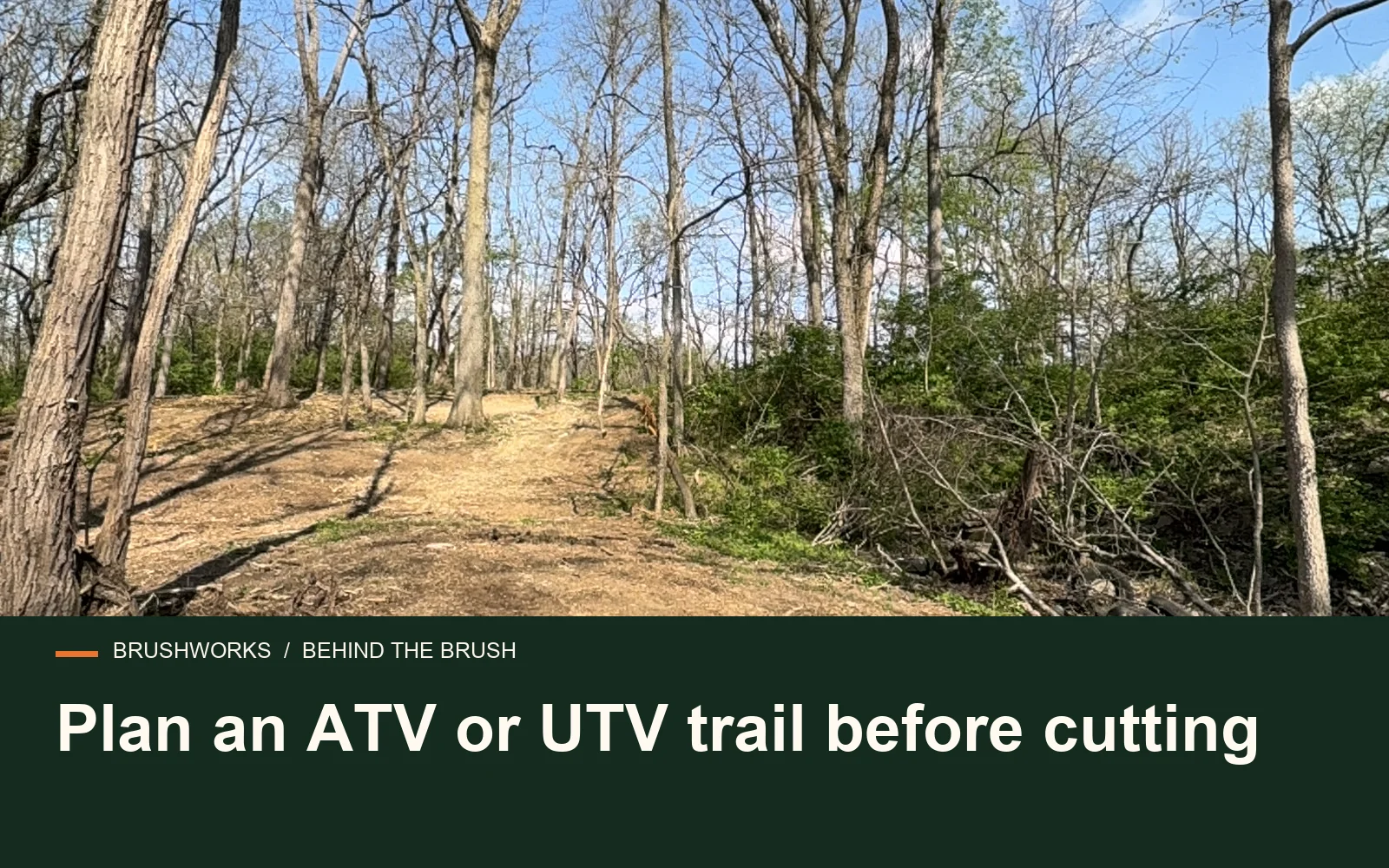
Mulching can open a corridor through suitable vegetation. It can leave roots, stumps, loose chips, and uneven ground. Those conditions must be evaluated before riding, and a mulched corridor should not be advertised as automatically safe or finished.
Specify drainage, tread shaping, stump work, and surface requirements separately. A trail used by vehicles has different needs from an occasional walking path.
Inspect before use and after weather
Walk or otherwise inspect the route safely before opening it to riders. Resolve obstructions and unstable areas first. Establish how users will know about closures or changed conditions.
Schedule checks after storms and as vegetation returns. A maintainable trail has room for the equipment and people who will repair it, not only the vehicle that fits through on opening day.
Use a route walk to find the expensive parts
Mark tight turns, crossings, blind approaches, soft sections, and places where the vehicle needs to stop or turn around. These details are easy to overlook when looking only at a line on a map. Include a route for maintenance equipment and a way to close the trail when conditions are unsuitable.
Ask the contractor to distinguish straightforward corridor clearing from construction work at each difficult section. A short crossing can be a separate design and permitting problem even when the surrounding trail is simple. Keep the route closed until those sections and the final surface have been inspected for the intended use.
Plan the work for your property
Send the site address, recent photos, a marked clearing area, and the finish you want. We can discuss where clearing fits and what needs a different trade.
Discuss your project → Explore pricing